wu jia pi
nan wu jia pi (southern wu jia pi) 按此看中英文頁 By: Joe Hing Kwok Chu
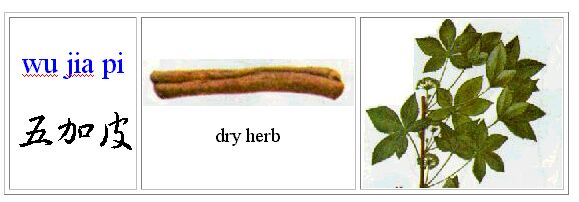
| Pharmaceutical name: | Cortex Acanthopanacis Gracilistyli Radicis |
| Biological name: | Acanthopanax spinosus Mig. (Acanthopanax gracilistylus Smith.) |
| Pron. in Japanese: | gokahi |
| Pron. in Korean: | ogap'i |
| Pron. in Cantonese: | ng ka pei |
| Common Name: | acanthopanax root bark |
| Distribution: | Henan, Sichuan, Hunan, Guangdong, Hebei, Shanxi, Shandong provinces of China |
| Properties (characteristics) | warm, spicy. bitter |
| Channels (meridians) entered: | kidney, liver |
| Actions & Indications: | dispels cold dampness pain, rheumatism, weakness in joints and muscles, aids in development of walking in toddlers, for urination difficulty, edema, and for reducing swelling. Dosage: 4.5~15 grams |
| Chemical Ingredients: | syringin, (-)ent-kaur-16-en-19-oic acid, 16 alpha hydroxyI-kauran-19-oic acid, stearic acid, d-sesamin, vitamins A and B, calcium oxalate, palmic acid |
| Modern Research: | northern wu jia pi is a heart stimulant which is toxic for the heart. |
| Caution: | Herb gatherers in the northern part of China usually use gang liu pi (belongs to the Sclepiadaceae family) as "northern wu jia pi." Most herb stores use northern wu jia pi in making wu jia pi wine. According to research of Zhao Zi Huang, long term use of wu jia pi wine causes death. Toxic reactions of wu jia pi wine made from northern wu jia pi include blindness, numbness in limbs, dizziness, and headache; long term use may cause death. Use caution in patients with yin deficiency and excessive heat. |
Also see Siberian Ginseng.
Last update: Oct 7, 2013; 11 a.m. LAH