(in English and Chinese 中英文)
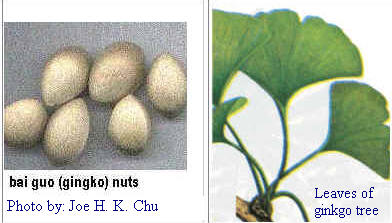
| Pharmaceutical name﹕ 藥名: |
Semen Ginkgo Bilobae |
| Latin botanical name﹕ 拉丁名: |
Ginkgo biloba L. |
| Pronounced in Japanese﹕ 日語發音: |
ginkyo (yin guo) |
| Pronounced in Korean﹕ 韓語發音: |
unhaeng (yin xing) |
| Pronounced in Cantonese﹕ 粵語發音: |
bak kwo, ngen kwo, ngen heng |
| Other Names﹕ 別名: |
yin xing 銀杏 , yin guo 銀果 |
| Common Name﹕ 英文名: |
ginkgo nut |
| Distribution﹕ 分佈: |
throughout China, from temperate zone to subtropical zone and some parts of north America. In the subtropical zone, usually they are found in the higher altitude where the climate is cooler. 全中國。亞熱帶到溫帶都有。北美有些地區。亞 熱帶的較高地帶。 |
| Parts Being Used﹕ 應用部份:
|
Traditionally, seeds were used. Now leaves are also being used for making extracts. 傳統上是用種子。現代也用葉來提煉有效成份。 |
| Characteristics﹕ 性 味: |
sweet, bitter, astringent, neutral, mildly toxic and very toxic for children. In the classical text of "Ben Cao Pin Hui Jing Yao" it states that the characteristics of the leaves of yin xing are bitter sweet, astringent, neutral. and belong to the lung meridian and can control the lungs and calm asthma, calm the mind and arrest pain, rid of water retention and stop diarrhea. 甘﹐苦﹐澀 ﹐性平﹐對成人有小毒﹔但都小孩則很毒。 《本 草品匯精要》中記載銀杏葉“味甘苦、澀、性平,歸肺經,能 斂肺平喘、益心止痛、化濕止泄”。 |
| channel (meridian) relation﹕ 歸經: |
nuts: kidney, lung leaves: lung 種子﹕腎﹐肺。 葉﹕肺。 |
| Actions & Indications﹕ 主治: |
Uses of bai guo nuts: As a tonic. Lowers sludge level in blood. Expels phlegm and stops wheezing cough. Eliminates damp heat, dampness and stops vaginal discharge in yeast infection. For incontinence, spermatorrhea (involuntary discharge of semen without orgasm), and frequent urination. 果實用于﹕ 可作進補用﹐去淤血﹐補肺定喘﹐去痰﹐止百日 咳﹐去濕熱﹐補虛止白帶﹐ 治遺精﹐ 對年老力衰、小便清長、夜間尿多者,有補腎縮尿的作用。 Uses of extract of ginkgo leaves:
The main usage of the ginkgo leave extract is in cardiovascular therapy (including dementia caused by circulation dysfunction.)
|
| Chemical ingredients: |
From the seeds:
1. Flavin type of compounds (黄酮類化合 物)
(1) flavonol:
kaempferol (山奈 黄素)[1], kaempferol-3-rhamnoglucoside[2] hepatasacetyl kaempferol glucoside[3], kaempferol-3(6'-p-coumaroyl-glucosy1)-b-1,rh-amnoside] [4], quercetin (槲皮素), isorthamnetin (異鼠李黄素)[1], octaacetyl quercetin 3-glucoside [3], rutin [2]. (2) flavin and its glucosides﹕ heptaacetyl luteolin glucoside, octaaccetyldelphidenon glucoside[3]. (3) dihydro-flavonol dihydro-catechin-pentaacetate, dihydro-epicatechin-pentaacetate, dihydro-gallocatechin-hexacetate, dihydro-epigallocatechin-hexacetate, are derivatives of catechin [3]. (4) bi-flavonol bilobetin, ginkgetin, sciadopitysin, I-5'-methoxy-bilobetin, a-mentoflavone [5] 2. Phenols ginkgolic acid, hydroginkgolic acid, ginkgolinic acid, ginkgol, bilobol [6], anacardic acid.
3. Organic acids quinic acid, linoleic acid, shikimic acid, asorbic acid [3]. Skin contains formic acid, propionic acid, butyric acid, caprylic acid.
4. Alcohol groups a-hexenol, sequoyitol, pinite, hexacosanol-1, octacosanol-1[3] , b-sitosterol , nonacosyl alcohol-10[10] ,ginnol [6]. 5. Trace minerals and others ginkgo-B (a saponin), d-sesamin [3]. Seed contains small amount of cyanophoric glucoside, gibberellin, cytokininlike substances. Protein 6.4, fat 2.4, carbohydrates 36%, calcium10 mg, phophorus 218 mg, iron, carotene 320 mg, riboflavine 50 mg, various amino acids. External skin contains asparagine.
From the leaves and branches: bilobalide,
(白果内酯), ginkgolide,B, (銀杏萜内酯B), ginkgolide C, (銀杏萜内酯C ), vanillic
acid, (香草酸), protocatechuic acid, (原兒茶酸 ), daucosterol,
(胡蘿蔔貳),octacosanol, (二十八醇 ), triacontanoic acid, (三十烷酸). |
|
Medical functions:
|
Medical functions: 1. Effect on Respiratory System 2. Effect on Smooth Muscles 3. Effect on Circulatory System 4. Effect on Brain Circulation 5. Effect on Free Radicals 6. Effect of Anti Bacteria 7. Other Effects 8. Toxicity Side Effect
Raw
ginkgo nuts are toxic. Over consuming can cause vomiting, pain in the
abdomen, diarrhea, muscle spasm, anxiety and difficulty in breathy. [31]
Some classical medical literature reported that over consuming had caused
death in a group of refugees. The outer skin of the fruit contains ginkgo
toxin. Ginkgo phenols and ginkgo toxin possess effect of hemolysis. Ginkgo
toxin possesses an anesthetic effect on the central nervous system of
frogs. A venous injection of 0.2g/kg on rabbits caused temporary raising
of blood pressure then with subsequent dropping of blood pressure, breathing
difficulty, panic and death. Using the neutral portion of the gingko seed
for skin injection of 6mg/kg had also caused death in mice.[3] Using a
large dosage of ginkgo leaf extract for venous injection continually for
one week on dogs causes salivating, vomiting, diarrhea, and lack of appetite.
In lab examination of tissues, it shows the increase of mucus secretion
of the lower abdomen. Local injection causes local blood vessels to harden.
It shows that in dogs and rabbits under anesthesia, the movement of intestines
increases. A normal amount of flavonol does not affect the blood clotting
time. A large dosage can interfere with the blood clotting time. Venous
injections of 242mg/kg, in 95% of the cases, 229.6~256.2/kg could be the
fatal limits), of di-flavonol were applied to mice and caused acute toxicity
symptoms of rapid breathing, sprawling still, and eventually all died
of breathing paralysis.[31]
1。對呼吸系統作用 生白果是有毒的。過度服用會引起嘔吐,腹部疼 痛,腹瀉,肌肉痙攣,焦慮和呼吸困難。 [31 ] 一些古典醫學文獻報導,一批逃難的難民在白果樹林拾取白果煮熟當飯吃造成的集體死亡。水果的外皮 含有銀杏毒素。銀杏酚和銀杏毒素具有溶血作用。銀杏毒素具有青蛙的中樞神經系統的麻醉作用。靜脈注射量0.2g/kg對家兔引起血壓的暫時提高再與血 壓隨後下降,呼吸困難,恐慌和死亡。用銀杏種子的中性部分皮下注射6mg/kg也致使小鼠死亡。 [3]對狗使用的銀杏葉提取物靜脈注射大劑量連續一 個星期會導致垂涎,嘔吐,腹瀉,食慾不振。在實驗室作組織檢查,它顯示了小腹的黏液分泌增加。局部注射引起局部血管硬化。這表明,在麻醉狀態下狗和兔 子,腸增加運動。正常量的黃酮醇,不影響血液凝固的時間。大劑量可對血液凝血時間干擾。 242mg/kg二黃酮醇的(在95 %的情況下, 229.6 〜 256.2/kg可能是致命的限制) ,靜脈注射被應用於小鼠,導致呼吸急促的急性毒性症狀,仍然蔓延,最終全部死亡的呼吸麻痺。 [ 31]
|
| Present Day Applications:
|
1. Labyrinthine syndrome 2. Pimples 3. Urolithiasis (formation of calculi in the urinary tract.) Formulae: root of gingko biloba 120 g, rock cane sugar 120 g. Boil with water. Taken orally. 4~5 doses a week. If there is infection of urinary track, use Ba Zheng San with bai hua she she cao. Drink plenty of liquid and excercise (editor note: preferably qigong dong gong). Out of fifty patients, thirty two were healed. Ten patients were improved. Eight patients did not improve. Average treatment time was 133 days. [3] |
| Sample of Formulae: |
Ding Chuan Tang for asthma, formulae for yeast infection, 定喘湯 治哮喘。帶 下方。 |
| Warning: |
Bai guo nuts
are
A normal amount of flavonol does not affect the blood clotting time. A large dosage can interfere with the blood clotting time. Venous injections of 242mg/kg (in 95% of the cases, 229.6~256.2/kg could be the fatal limits), of di-flavonol were applied to mice and caused acute toxicity symptoms of rapid breathing, sprawling still, and eventually all died of breathing paralysis.[31] |
Ginkgo trees do not tolerate high heat or extreme cold. Although the trees are found in more than twenty provinces in China but in many locations they do not bear fruits or bear scanty amount of fruits. In Guilin of Guangxi province in southern part of China,
where the altitude is between 280 meters to 600 meters, where the four seasons are distinct, and with abundance of rain water and fertile soil, the ginkgo trees grow well. It is one of the main ginkgo production areas.