Complementary and Alternative Healing
University

Site Map
List of Health Problems | Chinese Herb Dictionary | Qigong| Traditional Chinese Medicine | Acupuncture | Prescribed Drug Dictionary | Biochemistry Dictionary | Lecture Slides | Research Librarian | Search |Viagra | Hypnotherapy | Qigong classes | Weather Report | Massage/Acupressure | General Online Library | Contact Us for Suggestion |
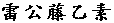
lei gong teng,
Tripterygium wilfordii Hook. F.
Translated and edited by: Joe Hing Kwok Chu
Best view with monitor display set at 1024X768
|
1. Description 5. Common Name 6. Distribution 7. Properties (characteristics) |
(1). Effects on immune system (2). Anti-inflammatory effects (3). Anti-cancer effects 11. Other Research 12. Modern clinical application 14. Antidotes
|
Description
The herb of lei gong teng comes from the roots, leaves and flowers of the tripterygium wilfordii Hook. f. It is collected during summer and autumn.
Lei gong teng is a deciduous climbing vine growing to 12 meters, with brown, angular, downy twigs. The leaves are light green, smooth on top, and pale gray with light hairs underneath. They have crenate margins and pointed apexes, and are ovate to elliptic, 5-15 cm long,
2.5 - 7 cm wide. The scented hermaphroditic (having male and female organs) flowers, which bloom in September, are small and whitish with five petals and are about 9 mm across, in terminal panicles in July. The fruit is 3-winged, and brownish red, about 1.5 cm long. The plant can grow in light (sandy), medium (loamy) and heavy (clay) soils. It can survive in acid,
neutral and basic (alkaline) soil. It can grow in semi-shade (light woodland)
or no shade. It requires moist soil.
Pharmaceutical name: Radix Tripterygium wilfordii Biological name: Tripterygium wilfordii Hook. f.
Pronunciation in Cantonese: lui kong teng Common Name: three-wing-nut
Folk Name: walk seven steps and die, intestine-breaking plant
Distribution: native of southern part of mainland China, Taiwan, Burma Properties (characteristics): bitter and very toxic Actions & Indications: for: anti-inflammatory, killing worms, resolving toxin, treating proteinuric renal disease, using as immuno-suppressive agent on autoimmune diseases.
Chemical ingredients:
1. Saponins:
(1). wilforgine, wilforgine-B,wilfordine, wilfornine, wilfortrine,
wilfortrine-D, wilforzine[1-3], wilformine [4], wilfordinic acid,
hydroxywilfordii acid [5],wilfornine [6], neowilforine [7] (2). celacinnine, celafurine, celabenzine, celallocinnine [8-9] (3). triptofordinine A-1, A-2 [10], triptofordin D-1, D-2, E [11],
triptofordin A, B, C-1 C-2 [12],
triptofordin F-1, F-2, F-3, F-4 [13]
2. Diterpene group
(1). triptolide, tripdiolide[14], triptonide,[14-15],tripterolide[16].
(2.). triptolidenol [16-17], tripnolide [18], neotriptophenolide,
triptophenolide methyl ether [19], isoneotrip-tophenolide, hypolide methyl ether [20].
(3). triptonoterpene, triptonoterpene methyl ether [17],
triptonoterpenol [21]12-ydroxy-abieta-8, 11, 13 -trien-3-one,
11-hydroxy-14-methoxy-abieta-8,
11-hydroxy-14-methoxy-abieta-8, 11, 13-trien-3-one [22].
3. Tetra-triterpene group
(1). wilforlide A, wilforlide B [23].
(2). tritotriterpenoid lactone [24], tretotriterpenic acid A [25, 26],
tritotriterpenic acid B [27], tritotriterpenic acid C [28], 3-epikatonic acid [29],
polpunonic acid, triptodihydroxy acid methyl ester [30], tripterine [31].
(3). 3,24-dioxofridelan-29-oic acid [29], salaspermic acid [29,32].
4. wilfornide [20]
5. 1,8-dihydroxy-4-hydroxymethyl anthraquinone [33].
6. syringareisnol [34].
7 Other Chemicals: dulcitol, glucose [31], tannin 8. trace mineral: iron, manganese, zinc, copper, selenium etc
Medical Functions:
1. Effects on immune system
2. Anti-inflammatory effects
3. Anti -cancer effect
Triptolide and tripdiolide
 ,
(
,
( )
are
)
are
highly effective in treating cancer.
Using alcohol extract of lei gong teng, triptolide or tripdiolide on mice with leukemia L1210, (50~400mcg/kg), showed that the therapy was highly effective [58].
The effective dosage for mice with L1210 and P388 was 0.1mg/kg. Using triptolide of 0.25mg and 0.2mg/kg on mice with leukemia L615, has proved to prolong the survival rates to more than 159.8% and 87.8% respectively and also has caused some of the mice to survive long term. Using spleen cell L615, once a month continually for three months to attack the cancer cells that survived long term, did not affect the survival rate of the mice or cause them to get ill [24,58,59].
4. Effects on contraception
5. Effects on urinary system
6. Effects on anti-organism and worms
7. Other Effects
8. Inhibits acute phase of rejection during transplant
Effect
of triptolide on cardiac allograft survival in mice
Zhou Xiaoming, Fang Xiangdong, Luo Aiwu, Li Quanqi, Li Jinsheng,
Wang Xiaoning1 (Cardio thoracic Surgery,Nan fang Hospital 1 Institute of Molecular Immunology, the First Military Medical University, Guangzhou 510515 2 Department of Pediatrics,
General Hospital, Guangzhou Military Area Command)
Keywords: triptolide cardiac allograft allograft rejection immunosuppression Abstract This paper was designed to evaluate the effect of triptolide (Tri)
on cardiac allograft survival in mouse ear. In our studies triptolide was demonstrated to suppress the rejection of cardiac allograft in mouse ear.
The effect was both doseª² dependent and timeª² dependent. In addition,
the studies also evaluated the effect of Tri on T- lymphocyte proliferation induced by Con A or mixed lymphocyte reaction (MLR) in vitro. The results showed that Tri notably inhibited T- lymphocyte transformation (LT)
at 0.04~10 μ g/L and MLR at 0.2~10 μg/L. All these inhibitory effects were timeª² dependent. Maximal inhibition of LT and MLR was observed when Tri was added in the first 12 hours of incubation. The effect of Tri on Con Aª² induced IL- 2 production and IL- 2R expression of lymphocytes was assayed. It was found that Tri at 0.4 μ g/L and 10 μ g/L had no significant inhibitory effect on the synthesis of IL- 2 by freshly isolated mouse splenocytes prestimulated with Con A for 24 hours and 48 hours. Examination of the effect of Tri on IL- 2 receptor expression indicated that Tri can reduce IL- 2R expression.
These results suggested that Tri could inhibit the acute phase of transplant rejection but not to prevent allograft rejection.
Editor Note: This may be an old document that has been retrieved.
Please contact researchers for any new information.
According to a report from Xin Hua She News of China, the acute phase of transplant rejection rate dropped from 30 ~40% to 5% using triptolide.
See the archived Chinese site of this article on inhibiting the acute phase of rejection in Chinese
9. Inside body
10. Effects of toxicity
Other Research: Four compounds purified from T. wilfordii may confer protection against the FSGS (focal segmental glomerulosclerosis)
factor.a
Modern Clinical Application :
Examples
1. proliferative arthritis
(1). Dosage per day for adults: 20 to 30 g of dried stem of lei gong teng.
Use low heat to simmer for 3 to 4 hours. Adjust the amount for children.
Take until symptoms are clear. Fifteen days after symptoms are clear,
change to every other day or every 3 days per dose; then slowly wean from it. If symptoms do not subside after 15 days, it is deemed ineffective.
There were 60 patients. Average stay in the hospital: 3 to 4 months.
Result: 17 healed.
Effective: 20. Better: 19. Not effective: 4.
The characteristic of this herb is warm and toxic. It is effective for acute cases. It is much less effective on cases with deformed joints. [1]
(2). Combining 2/3 of lei gong teng with bark and 1/3 without bark and made into 15% tincture. Dosage: 10 to 15 ml per day, made into 3 servings for after meals. Continuously taken for 3 to 5 months (average 4.5 months).
After symptoms are controlled, dosages were decreased. Result: Clinically healed: 18. Obviously improved: 95. Better 46. Not effective: 6. Total effectiveness: 96.4%.[2] (3). Total saponins dosage 1 to 1.5 mg per day, into 3 servings, taken after meals. The largest dosage was 90 mg. While using this therapy,
other medicines were suspended.
After 1 to 2 weeks, the symptoms started to subside. After treatments,
ESR and other values of proliferative arthritis indicators started to decrease. Some of them became normal. EgC, IgA, and IgM obviously decreased. After more than 3 months of therapy,
among 136 patients, with lesser clinical symptoms : 24, obviously improved: 51,
improved: 52, ineffective: 9, total effectiveness: 93.3%.
(4).
(5).
(6).
2. tonic inflammation of spinal cord
3. lupus
4. purpura
5. kidney inflammation
6. asthma
7. tuberculosis of the lungs
8. psoriasis
Using water decoction of lei gong teng and alcohol extract of lei gong teng:
They both contain 50 lei gong ten 50 g, and ji xue tang 50 g each. Take orally 50 ml, twice a day after meals.
30 days is one therapy period.
Result:
Total patients: 193
Patients taking alcohol extract: 116 Effective rate: 86.2% Patients taking water decoction: 77 Effective rate: 72.72% It showed that the alcohol extract was more effective than the water decoction. [21]
9. dermatitis
10. Reiter syndrome
Research on Pharmacological Processes: to be loaded
Toxicity and Side Effects:
There are 3 types of toxicity: [A]
-
1. Acute toxicity: within a few hours after using the medication, multiple organ damages, even death.
-
2. chronic toxicity reaction: usually symptoms of organ damages appear during treatment period with lei gong teng, with slow progression.
-
3. relapse of toxic reaction: after treatment of acute toxicity reaction, after certain period the symptoms return.
1. Toxic reactions: dizziness, palpitation, weakness, nausea, vomiting,
stomach ache, diarrhea, pain in liver and kidney areas, bleeding in the digestive tract, even respiration and circulation exhaustion and death.
2. decrease of total blood cell counts (2)
3. mutation type of illness: using lei gong teng tincture for external use can cause mutation type of illness. (3)
4. Long term use of lei gong teng could significantly decrease bone mineral density of levels in female systemic lupus erythematosus (SLE)b 5. long term use of lei gong teng causes hair loss and malfunction of immune system.[c]
Antidotes:
I. Prevention
1). For external use: use ointment and avoid tincture.
2). Pay attention to the dosage according to the body constitution of individual patients.
3). Avoid using on patients with liver problems.
II. Antidotes for toxicity
1). Empty stomach and induce diarrhea.
2). During the early stages, use adrenocortical hormone.
Dexamethasone 5~10mg with added 50% glucose 40 ml can be used in IV administering, followed with dexamethasone of 1.5mg,
3 times a day for 2~3 weeks. anisodamine (654-2) can also be used.
3). Use dextran 40 (low Molecular Dexran, Rheomacrodex) 500ml IV administering, when toxin has been absorbed but no symptom of toxicity. 20% solution of Manitol for IV administering, and furosemide 40mg (Frusemide,
Fursemide, Lasix) for muscle injection. Pay attention to the balance of electrolytes and correct acidosis immediately.
4). Skin allergy can be treated with antihistamines or with traditional Chinese herbs for dispersing heat and neutralizing toxin.
5). Chinese herb treatment:
-
(a) fresh feng wei cao (Pterismultifida Poir) 250 to 500 g each time. Or combine with jin qian cao, wu kuai, tian qi. This single item formula has been successfully used to treat more than 10 serious cases. The combined formula has been used successfully on 7 cases including one who almost died for the toxin.
-
(b) yang mei (Myrica rubra.et Zucc) : drinking juice of the fruit, 100 cc to 200 cc, every 1 or 2 hours, gradually decrease the volume was successful in treating a patient who breathing and heart rate were suddenly stop. Using or bark or root of yang mei 60 to 250 g each time, 2 to 3 times a day is also effective.
Other related websites:
Click to see picture on another site
Note: If you need the complete bibliography or other information in a hurry, please email our Research Librarian. There is a set up charge.
Almost all of them are from sources of Chinese writings.
[A] according to the study of Li Rui_lin and Shu Da-fu et al 李瑞琳、舒達夫等 (a). M. Sharma, R. Sharma, XL Ge, R.S.Reddy, E.T.McCarthy, V. J. Savin, Medical College of Wisconsin, Milwaukee, WI, U.S.A.
(b). Department of dermatology, Huashan hospital, Shanghai Medical University, Shanghai 200040, China (Huang L and Feng SF); Radiology Institute, Shanghai Medical University,
Shanghai 200040, China (Wang HF).
Site Map
List of Health Problems | Chinese Herb Dictionary | Qigong| Traditional Chinese Medicine | Acupuncture | Prescribed Drug Dictionary | Biochemistry Dictionary | Lecture Slides | Research Librarian | Search | Viagra | Hypnotherapy | Qigong classes | Weather Report |Massage/Acupressure |
General
Online Library |
Contact Us for Suggestion |
|
Last update: Dec 1, 2003; 1:20 p.m. RC